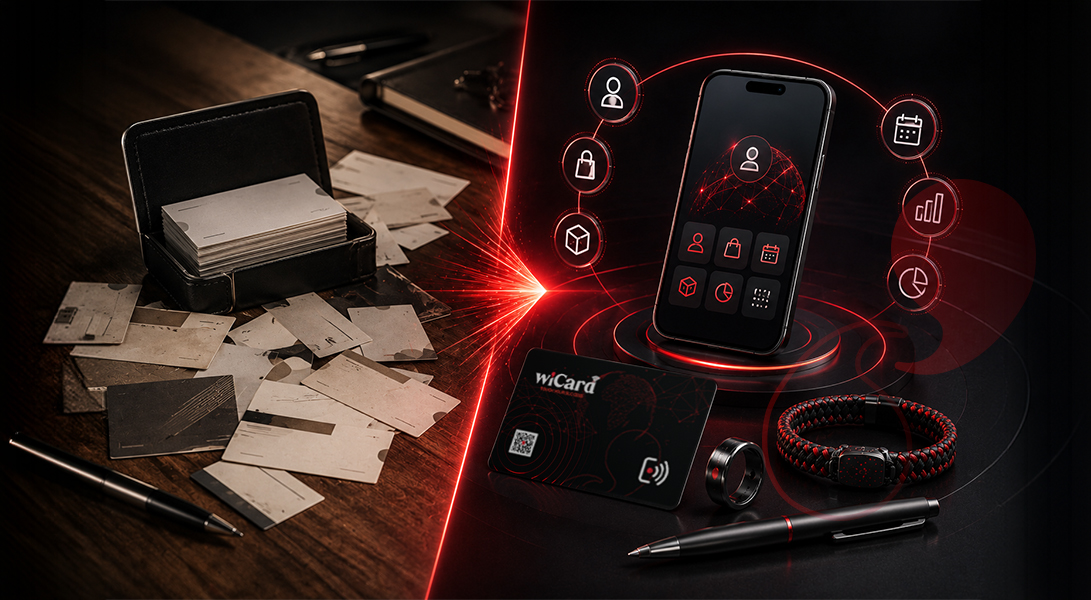
How Much Money Companies Waste Printing Business Cards

The Hidden Cost of Traditional Networking
For decades, printed business cards have been considered an essential tool for professional networking. From trade shows and conferences to client meetings and sales presentations, organizations have relied on paper business cards to share contact information and build business relationships.
However, as companies continue embracing digital transformation, many business leaders are beginning to question whether traditional business cards still make financial sense.
The reality is that most organizations significantly underestimate the true cost of printing, managing, replacing, and distributing paper business cards. What appears to be a relatively small expense often becomes a recurring cost that grows substantially over time.
In today's increasingly digital business environment, organizations are discovering that traditional business cards may be costing far more than they realize.
Let's examine how much money companies actually waste on printed business cards and why digital alternatives are becoming the preferred solution.
The Direct Cost of Printing Business Cards
Most companies focus only on the initial printing expense.
At first glance, business cards seem inexpensive.
Typical expenses include:
- Design costs
- Printing costs
- Premium paper materials
- Finishing options
- Shipping fees
A standard employee may receive 500 to 1,000 business cards per order.
While the cost per card may appear low, multiplying that expense across dozens or hundreds of employees quickly increases the overall budget.
Örneğin:
A company with:
- 50 employees
- Two print orders per year
- Average annual printing cost of $40 per employee
Would spend approximately:
$2,000 annually
simply on printing.
Larger organizations with hundreds or thousands of employees can easily spend tens of thousands of dollars every year on business card production alone.
The Hidden Cost of Reprinting
Printing costs are only the beginning.
Business information changes frequently.
Employees may update:
- Phone numbers
- Job titles
- Departments
- Office locations
- Email addresses
- Company branding
Every change often requires new business cards.
This creates recurring expenses that many organizations fail to include in their networking budgets.
In fast-growing companies where promotions, restructuring, and expansion occur regularly, reprinting can become a continuous cycle.
Many organizations end up paying for multiple card versions for the same employee within a single year.
Employee Turnover Creates Significant Waste
One of the most overlooked costs is employee turnover.
When employees leave an organization, unused business cards typically become worthless.
Consider a company that prints:
1,000 cards per employee.
If an employee leaves after using only 200 cards, the remaining 800 cards are discarded.
Now multiply this scenario across multiple departments over several years.
The waste becomes substantial.
Organizations often underestimate how much money is lost through unused inventory that can never be recovered.
Storage and Distribution Costs Add Up
Physical business cards require management.
Companies must allocate resources for:
- Inventory storage
- Ordering processes
- Distribution
- Design approvals
- Vendor management
While these expenses may seem minor individually, they create administrative overhead that consumes both time and money.
Procurement teams, marketing departments, and administrative staff frequently spend valuable hours coordinating business card production.
These labor costs rarely appear on accounting reports but contribute significantly to the overall expense.
Trade Shows Multiply Costs
Business cards remain popular at conferences, exhibitions, and networking events.
However, event participation often increases printing requirements dramatically.
Many companies produce:
- Additional card inventory
- Specialized event cards
- Regional versions
- Promotional inserts
The result is even higher spending on materials that may only be used for a single event.
In many cases, a large percentage of printed cards are never distributed.
Most Business Cards End Up in the Trash
Perhaps the most alarming statistic is how quickly paper business cards lose value.
Many recipients:
- Misplace cards
- Forget about them
- Discard them
- Never enter the information into their contacts
Even when a card is successfully distributed, there is no guarantee it will generate any business value.
Organizations continue spending money on materials that often fail to produce measurable results.
From a return-on-investment perspective, this represents a significant inefficiency.
The Opportunity Cost Is Even Greater
Beyond direct financial losses, companies face another challenge: missed opportunities.
Traditional business cards provide limited information.
A recipient receives:
- Adı
- Phone number
- E-posta adresi
- Web sitesi
But modern buyers often want immediate access to:
- Ürünler
- Hizmetler
- Portfolios
- Case studies
- Social media profiles
- Booking systems
A paper card cannot provide these experiences.
This means organizations may be losing potential leads simply because their networking tools fail to meet modern expectations.
How Digital Transformation Changes Networking
Digital transformation is reshaping nearly every aspect of business operations.
Organizations have already digitized:
- Pazarlama
- Satış
- Customer support
- Finance
- Human resources
Networking is following the same path.
Digital Business Cards allow companies to eliminate recurring printing expenses while providing significantly greater functionality.
Instead of distributing static paper cards, employees can share dynamic digital profiles containing:
- Contact information
- Hizmetler
- Product catalogs
- Appointment booking
- Social channels
- Company resources
This creates a more engaging and effective networking experience.
The Financial Benefits of Digital Business Cards
When companies adopt digital business card solutions, they often experience immediate savings.
Benefits include:
No Reprinting Costs
Information can be updated instantly without printing new cards.
Reduced Administrative Work
No inventory management or ordering processes.
Lower Long-Term Expenses
One digital profile can replace thousands of printed cards.
Improved Lead Generation
Recipients gain access to interactive content rather than static information.
Better Return on Investment
Organizations can measure engagement through analytics and performance tracking.
These advantages make digital networking a logical extension of broader digital transformation initiatives.
Sustainability Creates Additional Value
Modern organizations are increasingly focused on environmental responsibility.
Traditional business cards contribute to:
- Paper consumption
- Waste generation
- Resource usage
By replacing paper-based networking with digital alternatives, businesses reduce their environmental footprint while supporting sustainability goals.
This can improve corporate reputation and strengthen ESG commitments.
Why Smart Companies Are Moving Away from Printed Cards
Forward-thinking organizations are recognizing that printed business cards belong to a previous era of business communication.
Today's networking environment demands:
- Speed
- Flexibility
- Digital accessibility
- Measurable engagement
- Sustainability
Digital business cards provide all of these advantages while eliminating many of the hidden costs associated with traditional printing.
As a result, companies are increasingly viewing paper business cards as an unnecessary recurring expense rather than a valuable business investment.
The Future of Cost-Effective Networking
The question is no longer whether digital business cards are replacing traditional cards.
The question is how much money organizations can save by making the transition sooner.
Companies that continue relying on printed business cards face ongoing expenses related to:
- Printing
- Reprinting
- Waste
- Distribution
- Administration
Meanwhile, businesses adopting digital networking solutions gain access to more efficient, measurable, and scalable communication tools.
In an era driven by digital transformation, reducing unnecessary expenses while improving business performance is a strategic advantage.
For many organizations, eliminating paper business cards may be one of the simplest and smartest cost-saving decisions they can make.